ad

ad

Why schools become battlegrounds during conflict

Last week, more than 100 girls who had been abducted by the Islamic militant group Boko Haram from a Nigerian school in Dapchi in February were released to their families. But the community was also threatened that if the group returned and found any girls in school, they would be abducted again – and not returned.

Meanwhile, in Syria, conservative estimates are that at least 4,072 schools have been forced to close, used as shelters, or destroyed due to the conflict. And there have been at least 1,292 attacks on schools in the Hama, Daraa, Homs, and Idlib provinces.

While a coalition of NGOs were presenting the findings of their #SaveSyrianSchools project in a public hearing in Geneva last week, another school was bombed in Syria, killing at least 15 children.

These examples reflect broader trends of targeting education across conflict-affected parts of the world. It is estimated that one in four school-aged children in conflict-affected nations are not in school. This is a total of around 27 million children. And girls are 2.5 times more likely to be denied an education.

Read more:  Aleppo's dying children and shattered health system: is there light at the end of the tunnel?

Why use schools as battlegrounds
There are many reasons why schools and students, despite being protected by international law, are targeted during times of armed conflict and unrest. Students collected together in a school, or isolated travelling to and from school, are prime targets for abduction by armed groups.

Children are often taken to be recruited as child soldiers, or used as human shields or human bombs. Schools are soft targets, and the targeting of children is very effective in campaigns of terror, having a destabilising effect on communities.

Schools and universities are also ideal locations for military headquarters and facilities, and can become central to war efforts. This makes them key military targets for opposing sides.
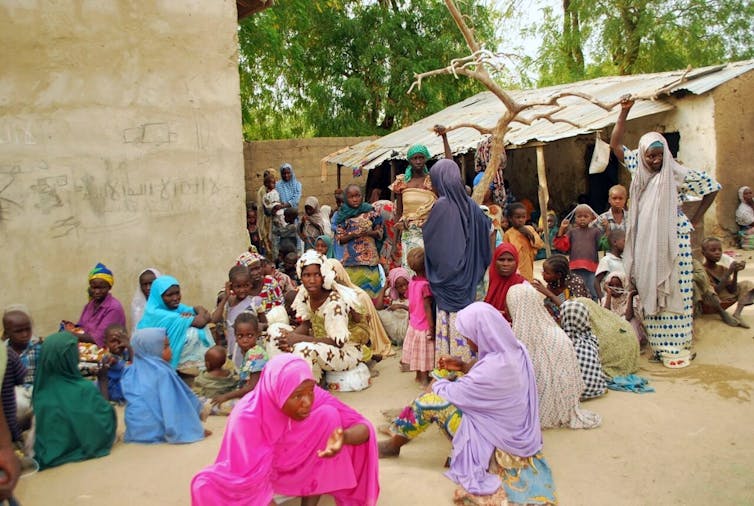
An internationally recognised move by Boko Haram remains that on the school in Chibok in 2014, where it abducted 276 children.

Schools can be seen by armed groups to represent state authority, and are therefore key targets in campaigns against the government. This is especially true when the groups disagree with the form of education being provided. This reality is perhaps best illustrated by Boko Haram, which in 2015 committed to the cause of Islamic State and renamed itself the Islamic State of West Africa.

Despite the change, the group remains best known as “Boko Haram”, which in the local Hausa dialect roughly translates as “Western education is forbidden”. Targeting schools and abducting children is a core strategy of the group, whose extremist beliefs oppose such education as sinful, and particularly object to the education of girls.
Boko Haram’s infamous 2014 abduction of 276 girls in Chibok sparked the #BringBackOurGirls social media campaign. According to Human Rights Watch, more than 910 schools have been destroyed by Boko Haram in Nigeria; 600 teachers have been murdered, and thousands have been more forced to flee.

What the rest of the world can do

All children have the right to an education, and that can only be secured when schools are safe places to study. While the world watches and encourages American children rallying to make their schools safer, it’s a salient time to remember that 75 million children worldwide experience significant disruption to their education in regions of conflict and insecurity.
Despite the United Nations declaring attacks on schools as one of the six grave violations that most impact on children during armed conflict, much remains to be done to safeguard education during conflict – particularly for girls.
This is largely because education is not seen as a priority in crisis situations. Its loss is not immediately life-threatening, so it often takes a back seat to other concerns. This forms part of what is sometimes referred to as “the humanitarian-development divide” – the disconnect between priorities during protracted crises. Education is often one of the first services to be lost during a crisis, despite its importance to communities.
Education attracts less than 2% of global humanitarian aid. Many affected countries invest far more on their military spending than they do on education.
While many initiatives and funds exist, there is still a need for greater coordination between government bodies and NGOs to effectively mount a response. And with countries slashing their aid budgets, this will become increasingly difficult.
There may also be a lack of political will to confront this problem by countries not directly affected. In Australia, this is reflected by the government’s current failure to endorse the Safe Schools Declaration – an international commitment supporting clear guidelines and reporting mechanisms to protect schools and education during armed conflict. These include the commitment not to use schools or universities for military purposes and to support measures to monitor and report on attacks on schools.
Education is a right, not a luxury to be indulged in better times. To rise out of conflict and create truly stable communities, education is a necessary investment in the future, and the international community shares a collective responsibility to protect it.

How biogas is creating jobs and promoting sustainable agriculture in Egypt

Twenty-four million new "green jobs" could be created worldwide using environmentally sustainable practices, according to the ILO's report, “World Employment and Social Outlook 2018: Greening with Jobs”. In a global context of wage growth stagnation, increasing income inequality and a growing number of people in non-standard employment, Egypt is turning to new green technologies that protect the environment while creating productive employment.

Quality education is the best guarantee against child labour

no_caption

Each year, Education International celebrates World Day Against Child Labour on 12 June. EI encourages education trade unions to participate in public activities in order to demonstrate the commitment of teachers’ and support staff to eradicating child labour and promoting quality public education for all.

According to the ILO estimates, 152 million girls and boys are still the victims of child labour, a scourge that is mainly concentrated in agriculture and the informal economy. Progress has been made in eliminating child labour and forced labour over the past 20 years, but it is necessary to increase the pace in order to achieve goal 8.7 of the Sustainable Development Goals: ending all forms of child labour by 2025.

According to EI, early schooling is the most effective way of getting children out of the labour market and giving them the opportunity to acquire the necessary skills for finding decent work in the future. Education and training are indispensable drivers of social and economic development, and democracy. They require public funding and accountability. In many countries, the schools accessible to disadvantaged families remain underfunded, poorly equipped and lack sufficient qualified staff.

For World Day Against Child Labour 2018, education trade unions are calling for:

·         Quality, free and mandatory public education for all children, at least until the minimum age of employment, and actions to reach those who are not currently in school;

·         Investments in education and social protection programmes;

·         The removal of all costs – both direct and indirect – linked to education and the implementation of incentive programmes to promote schooling;

·         The recruitment of new teachers, as well as adequate rights and professional conditions for the teachers (in accordance with the ILO/UNESCO Recommendation concerning the status of teachers);

·         An approach focused on the transition from school to decent work opportunities.

This was the message put forward by the representatives of governments and employer and worker organisations at the 5th World Conference on the Sustainable Elimination of Child Labour, in Buenos Aires (14-16 November 2017) when they declared in the final statement their commitment to “Strengthening the policies and programmes aimed at ensuring equal access for all children to mandatory, public and free education ensuring that children, and particularly girls and other children in precarious situations, are included in an inclusive and quality education system”.

In parallel to their advocacy activities, many education trade unions affiliated to EI are involved in field activities aimed at combating child labour. This is the case, for instance, in Mali, Nicaragua, Uganda and Zimbabwe where, during the 2014-2017 period, over 16,000 children were taken out of work and placed in schools or avoided early drop-outs thanks to projects creating areas free of all child labour. The teacher trade unions contributed to the development of such areas alongside local authorities and other civil society organisations. The involvement of EI affiliates in those projects has strengthened their influence in social dialogue while enabling them to increase their visibility and their memberships.

You can also read the World of Education's blogpost by Noumoutieba Diarra on trade union work to fight child labour in Mali here.

10 things about Harvard graduates: Liberals, virgins and iPhones


Harvard
Harvard University has been a launch pad for many high-powered careers - and this summer has seen another crop of graduates leaving the flagship US university.
But if these are going to be the next generation of political and business leaders, what are their beliefs and experiences?
The Harvard Crimson student newspaper has carried out a close-up survey of these new graduates, showing their attitudes on politics, sex and technology.
Here are 10 things revealed about this new young elite.
1. An anxious generation. Among the class of 2018, 41% have at some point sought mental health support from the university's health services. About 15% had also sought support off campus. It's a striking reminder that these young people have studied at a time of rising concerns about stress and wellbeing on campus.
2. More than one in five leave Harvard as virgins. There was a similar number who had never had any "dating" experience while at university. Where dating did take place, dating apps were used by 69%. But more than a fifth of these new graduates reported having been "sexually harassed" at some point during their time as students.

3. Liberals in a Trump era. Politically these young graduates, who began at Harvard during the Obama administration, are opponents of the current presidency, with 72% saying the US is going in the wrong direction. Only 3% of those who voted backed Donald Trump, and two-thirds of these graduates describe themselves as liberal or very liberal.


4. Campus free speech? There were signs that students are self-censoring their views and not debating openly. About two-thirds of students had "at some point chosen not to an express an opinion in an academic setting out of fear it would offend others". This was particularly the case for Republican supporters. But almost half of students wanted to have "trigger warnings" if courses were going to include something that could be upsetting or offensive.
5. Raising a glass. Alcohol has proved to be the most durable of student diversions. Even if these young people are seen as over-stressed high achievers, they're still very likely to have a drink. More than 90% drink alcohol, and most drink every week. But tobacco has virtually been entirely stubbed out. There are almost no regular smokers, and more than three-quarters have never even once smoked tobacco. More students had tried cannabis than tobacco.


6. School shootings. There have been high-profile protests by young people in the US in the wake of school shootings. Harvard students backed calls to restrict access to firearms, with almost nine in 10 supporting tighter gun control.
Smartphones
7. Smart students, smartphones. This is a cohort of students completely immersed in digital technology. Almost all of these new graduates own a smartphone, which are so prevalent that they're almost taken for granted. There is a strong bias towards iPhones, used by 87% of those leaving Harvard, with 80% using some other Apple computer device.
8. Harvard introduced an honour code in which students promised not to engage in academic cheating. But this survey suggests that this has not changed behaviour and that levels of cheating have remained broadly the same, with about a fifth of students owning up to having cheated at some stage. Very few of these say that this was detected.

9. Widening access. Entrance to top universities is always controversial. More than 60% back the principle of affirmative action and prioritising the admission of some students based on ethnicity. It was most popular among black and Hispanic graduates and least popular among Asian and white graduates.

10. What next? These graduates are entering an era of polarised views. It's also a United States divided by geography. These new high-flyers are not going to be spread across the country - they're planning careers that will see them clustering in three areas, New York, Massachusetts and California. About a 10th expect to head overseas. The biggest job destinations immediately after college are consulting, finance and technology. But if this gives a picture of where the new money will be made, 60% of the new graduates still expect to be depending on money from their parents.


PRINCETON UNIVERSITY.... GRADUATION PICS2